Welcome to the 2021 ultimate guide for various types of baseboards for residential & commercial space interior designs.
Before go further, let’s take a look at what is baseboard. You may hear plenty of different calling: floor molding, base molding, skirting, skirting board,mop-board, all of these names represent the same thing, the material on the bottom of the wall connecting to the floor, meaning it is what we are going to talk about – baseboards.
Actually, the baseboard is extremely useful, as well as adding a little extra visual interest to the home. The most important reason the baseboard exists is to cover the joints between the flooring and the walls. This will contain any leaks, hide any imperfections, avoid scratching things up, and avoid getting things stuck in the cracks and crevices that the two materials butting up against each other create.
Besides the functional application, the baseboard is becoming kind of a decorative piece as well. Baseboard and molding add decorative accents and personality to a space that can subtly be carried throughout the entire room or even the whole building.
There is a large amount of different types,styles and selections that need to be arranged in a certain way before making a decision for right baseboard for your project.Here are some recommendations and options
Types of Baseboard Molding
Lots of shapes and sizes of baseboards are available, and each is used for a different interior design, where it be decorative or functional. According to personal desire and what types you choose, some of the types of baseboards can be combined with each other to reach a more complicated profile. The most common combination is that add a quarter-round shoe molding on the bottom of three inches rounded baseboard.
Three-inch rounded & Stepped Baseboard
One of the most commonly used residential baseboards is the three-inch rounded or stepped baseboards. This because the top of the baseboard tapers off to give a softer more decorative corner. While still mildly decorative it is one of the less expensive options, due to its popularity. This is most commonly used in a contemporary design, but also it simple enough to blend into almost any style.
There are many variations of top corner shapes, which enrich the round corner baseboard family and give more design collections.
Quarter Round Baseboard Trim
Quarter round baseboard, also called Scotia Molding,is one-quarter of a circle as the name it is. This type of molding is installed along the bottom of the baseboard, and offers a fine finish to the baseboard,and hides any gaps between the baseboard and the floor.
Not all types of baseboards are good for adding shoe molding or quarter-round baseboard.The bottom of the baseboard must be flat to accept the molding. Some more ornate baseboards feature grooves, slants,and curves within the lower 3/4 inch, which would prevent shoe molding from fitting flush against the baseboard.

Baseboard with Corner Blocks
Corner Blocks are a fantastic addition to a home, especially you are having a problem cutting a perfect miter. This type of corner is available in two shapes, Square-Cut Blocks and Round Corner Blocks,both of them are created to complement any decor and save installing time. They can also serve as a corner protector in high-traffic areas.
Corner Block is a universal corner piece for all types of baseboard, and it is not an exact profile matching piece for specific baseboard design

Square Baseboard Flat Baseboard Molding
As a very common and basic style, flat or square baseboard gives a sharp clean look. We can have this type of baseboard in most of the materials and this type of baseboard is good to be used for most of the interior spacing design. Instead of the rounded corner mentioned above,it has squared-off corners that offer a more sophisticated look.The back of this type of baseboard trim is grooved to avoid be bending and makes it easier to install.

Baseboard Profiles
The profile of the baseboard is how it looks from the side, so basically the height and shape of the baseboard itself. This is where you can get creative in the way that the baseboard looks. Some of the most typical options are as follows.
Cover Trim Baseboard
Cover baseboard molding is an easy and good solution for refreshing old baseboard trim without removing the old piece. The cuts out of back allow us to place the new baseboard directly over the old existing molding and still lie flush to the wall.The cover trim molding works for three inches or below-size baseboard because of the limited cut size of the back. The front design of the cover baseboard is very simple ,it usually comes in flat or with small rounded corner on the top.


Sculpted Mid-Height Baseboard Trim
The mid-height sculpted baseboard trim,size range from 4 to 5-1/2 inches tall and about 5/8 inch thick. It is shaped in a decorative fashion with different accents on the top portion of the trim. The decorative look can be something like steps, scallops, grooves. This type of baseboard trim is a more formal type for house decoration.
Sculpted Tall Baseboard Moulding
Commonly the height of baseboard from 5 inches to 7 inches, we call it Tall Baseboard,and it is also a 3/4 or 5/8 inch thick. This type of trim has some decorative top edge with Mid-Height sculpted baseboard,just a taller version. These baseboard designs are used in high ceiling space areas or extremely large space areas to keep the right proportions avoiding make trim or moldings look tiny.
Styles of Baseboard
Now to match the style of your baseboard to the style of your home can be a little tricky after you factor in all the other things you have to consider. Below are a few examples and suggestions per some styles of home.
Colonial Baseboard
Colonial architecture takes a large part of American story during the 17th and 18th centuries. The colonial-style mouldings are inspired by the refined and classical Georgian period with its Palladian influence of proportions and details.
Colonial baseboard prefers white color and natural wood and are coordinated with crown molding & chair rail molding in a colonial style house.It is the most commonly used and quite classical baseboard molding design and we still see lots of them in space even the house is not colonial style.
Modern Baseboards
In favor of clean, straight lines, getting rid of ornamentation, and bulk of dramatic elements, modern design follows the “ minimal” principle.The shape of the modern baseboard is going to be clean and simple,do not have any decoration to it. The color of the baseboard is recommended to be similar to the wall color or just simple white. This fits with “ Neutral is the name of the game “.
For more adventure, there are many modern baseboard styles coming out that feature a stepped design with straight edges. Take a look at these popular stepped design baseboards.
Craftsman Style Baseboard
Beginning in the last years of the 19th century, American Craftsman is an American domestic architectural style. Craftsman styles rejects Victorian era excesses and welcome to “ man-made” over “ machine-made “ materials. Craftsman style trims & baseboards are very simple, like flat baseboard together with shoe molding.
Farmhouse Baseboard
Farmhouse baseboards are different from other normal baseboards because that they are designed to match classic farmhouse decor. There are some key characteristics on these baseboards,so you can know it is farmhouse style easily.
Typically farmhouse baseboard is very simple and traditional colors are usually preferred. We also see some farmhouse baseboard trim looks elegant.
Baseboard Molding Materials
There are plenty of materials that can be shaped into baseboard molding,and most of them are available in any of types , styles and profiles we mentioned above.Wide collection gives us more choice,meanwhile make us crazy when we are choosing baseboard for our home. Here are some baseboard materials for your reference.
Wood Baseboard
Wood baseboard comes from nature and is a beautiful, high-end of baseboard for home decoration.The most common types of wood used for making baseboard are :
Hardwoods: Poplar, Cherry, Oak,Maple, Walnut
Softwoods: Pine
The hardwood baseboard is strong, durable, and easy to be stained.The surface of the hardwood baseboard is available in unfinished & prefinished in the factory. If the wood baseboard does not be primed,it will take you a little more extra time to work on it, and final look tells you it is worth it.
Pine baseboard is cheaper than other wood materials and normally it is “joints” which is glued together that may contain harmful chemicals. Pinewood baseboard is primed and ready for topcoat.
MDF Baseboard
MDF stands for medium-density fiberboard, which is what it is made of . MDF is one of the most basic forms or baseboard ,but interest can be added by forming it into and profile and painting it the color of choice.MDF is typically painted since it does not have a good grain to stain or whitewash.
This product is easy to use since it is soft and usually pre-primed, meaning an extra step a self-installer can avoid.MDF is also a well-priced material, running about $0.65 to $0.9 per linear foot .While MDF is low budget and easy-to-use product,it is not as friendly for the environment.MDF is made of resin,and wood fibers heated and pressed to the extreme to create the baseboard.This resin that are used as binders contain formaldehyde , which can off-gas especially when wet
Polyurethane Baseboard (Urethane Baseboard )
Polyurethane material is a large family chemical material. The polyurethane baseboard we mentioned is using high-density rigid polyurethane foam material which is strong than wood, normally a good quality polyurethane baseboard reaches 200-250kgs /cbm density . Urethane baseboard is a molded baseboard, which is casting by liquid material injected into metal mold. Polyurethane material can be transformed to different architectural moldings, such as carved cornices, crown molding,baseboard ,chair rail molding, panel molding , ceiling medallion, columns, corbels, door casing, and other decorative accessories.
This type of baseboard is primed in the factory and ready to any paint by yourself.It is very easy to cut with common tools and lightweight, water-resistant, good for interior & exterior. Polyurethane baseboard has a large selection from 8cm to 20cm in height, a smooth surface, and carved decorative surfaces.

High-Density PS Baseboards / Polymer Baseboard
PS baseboard is a kind of environment-friendly baseboard type. Recycle the waste EPS foam and other waste plastic to turn into a good-looking decorative baseboard, save millions of trees and reduce thousands of tons of CO2 per year.
- No more mold or mildew
- No more water damage
- No more termite damage
- 90% recycle
- NO VOC
- Various wood textures

Vinyl Baseboard
Vinyl baseboards use the same material as vinyl siding.Normally vinyl baseboard is designed with hollow back with very thin thickness and it is available in any colors. Vinyl is a cost-effective material , but vinyl baseboard is not strong as other materials we mentioned before.It can crack or curl over time and they are not be painted.


Rubber Flexible Baseboard
A flexible baseboard is designed for curved walls.It feels like soft rubber materials and available in most of styles, types. The rubber baseboards come in 8feet long and also be stained or paint by yourself after install. The rubber flexible baseboard shares the same profiles with rigid straight baseboard molding which gives you a good match on joints.

Tile Baseboard
Tile baseboard is made by cutting standard tile into specific width strip, like 100mm width by 800mm length, we call this type of square strip “ tile baseboard “.It is a cost-effective way to save materials, no need to buy an extra baseboard. Extra tiles will be enough.


Metal Baseboard ( Aluminum Skirting )
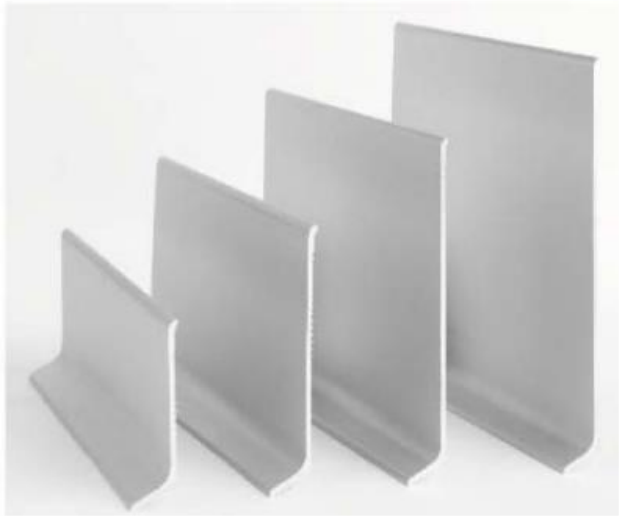
Aluminum skirting usually has 1.3mm thickness and with a smooth lines fashion design. It is produced through the oxidation process, and metal baseboard is not easy to fade, not easy to corrode, waterproof and wear-resistant. Each metal baseboard profile has a matching exterior corner, internal corner,joint piece, end cup , which of these make the installation easy and seamless.
Metal baseboards are often used in modern design spacing as they bring a metal shinning effect and fit its modern look.
LED Lighting Baseboards
Adding a lighting effect on the baseboard gives a fresh new look for your floor. There are two common materials of baseboard lighting molding, Aluminum baseboard lighting & PS baseboard lighting. A led strip is needed to be an insert. See below some photos of baseboard lighting profiles.


Self Adhesive Baseboard / Peel and Stick Baseboard
Peel and stick baseboards are made of high-quality PE foam, soft, high elasticity. As the name, it is, the advantage of this type of baseboard is that installing no need tools, just peel the back and stick the baseboard to the wall.
Self Adhesive baseboard is printed with realistic wood texture and grain that is easily mistaken for a real wood baseboard. Peel and Stick baseboard adhere well to Poly Paper, Vinyl, and even fabric materials and can be reapplied multiple times.


